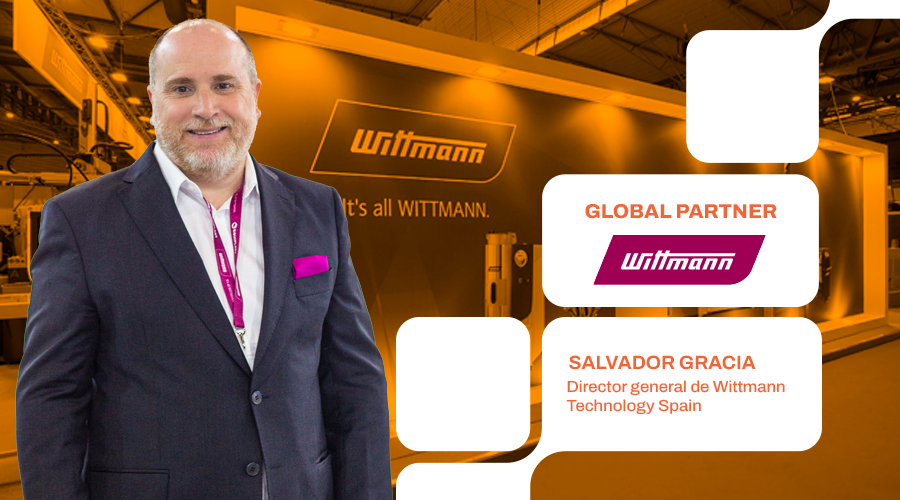
Interview with Salvador Gracia, General Manager of Wittmann Technology Spain
Salvador Gracia, General Manager of Wittmann Technology Spain, discusses the group’s global role, the value of technological integration, and the challenges shaping the future of injection moulding
Wittmann Group is an international benchmark in injection moulding technology. How would you describe the group’s current role in the global market, and what is the significance of the Spanish subsidiary within its structure?
Currently, the Wittmann Group ranks among the world’s leading companies in the manufacture of injection moulding machines, robots, and peripheral equipment. The group’s technological development progresses with a strong environmental commitment, focused on the conservation of natural resources and aligned with the principles of the circular economy.
This commitment is expressed, on the one hand, through process innovations that maximise energy efficiency, and on the other, through the development of solutions that facilitate the use of raw materials with a high recycled content, as well as new renewable materials. In this context, sustainability, digitalisation, and new materials have become the driving pillars of our growth.
Wittmann works to offer clients processes and solutions that enable real resource savings without compromising economic viability or long-term sustainability.
From an organisational perspective, the group has two main divisions and its headquarters in Vienna. It also has ten production plants across seven countries and 35 subsidiaries in key international markets. Within this structure, the Spanish subsidiary was one of the first to be established, making the Spanish market a reference point for its adaptability and dynamism, even amid the uncertainties and global challenges of recent years.
Their model is based on providing “all injection moulding technology from a single supplier.” What specific advantages does this integration offer clients?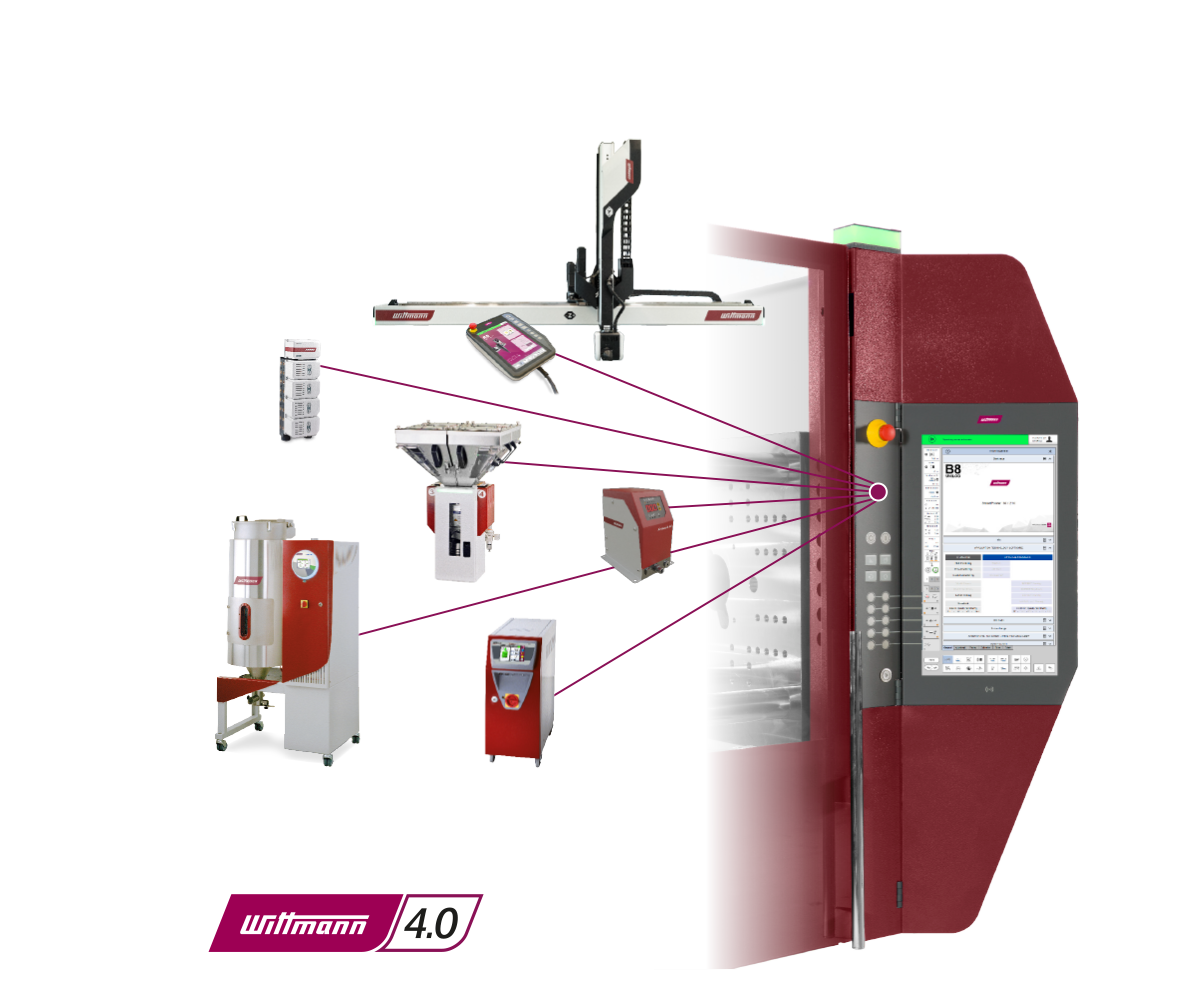
Wittmann’s portfolio includes injection moulding machines, robots, and automation systems, along with material feeding and transport equipment, dehumidifiers, dosing units, grinders, temperature controllers, and chillers. This product breadth, combined with accumulated experience and continuous technological development, positions Wittmann as the only comprehensive supplier capable of providing all equipment under a single brand.
This integration enables the provision of innovative systems and fully integrated work cells, resulting in a high level of efficiency and quality in production processes. Digitalisation ensures optimal connectivity between all equipment, with real-time data exchange, allowing anomalies to be detected and corrected quickly and effectively. All systems are designed for horizontal and vertical integration, giving rise to the concept of an intelligent production cell.
Innovation is one of the group’s pillars. Which technological areas are currently the focus of development?
One of Wittmann’s main objectives is to offer processes and solutions that are both economically and environmentally efficient, optimising resource use. Within this framework, current innovations are grouped into four main areas according to the type of savings they provide.
We focus on reducing energy consumption, minimising plant space requirements, shortening cycle times, and improving repeatability. In addition, we optimise raw material consumption in the injection process, with particular attention to the use of recycled materials and new sustainable materials, such as post-consumer and biodegradable materials.
Sustainability has become an unavoidable challenge for the plastics industry. What solutions do you propose to reduce energy consumption and emissions?
There are multiple solutions aimed at this goal. All our EcoPower series fully electric machines incorporate the KERS system, which allows braking energy to be used to power different parts of the machine, such as the injection unit heaters or the control system. The use of servo-electric drives also contributes to achieving maximum energy efficiency.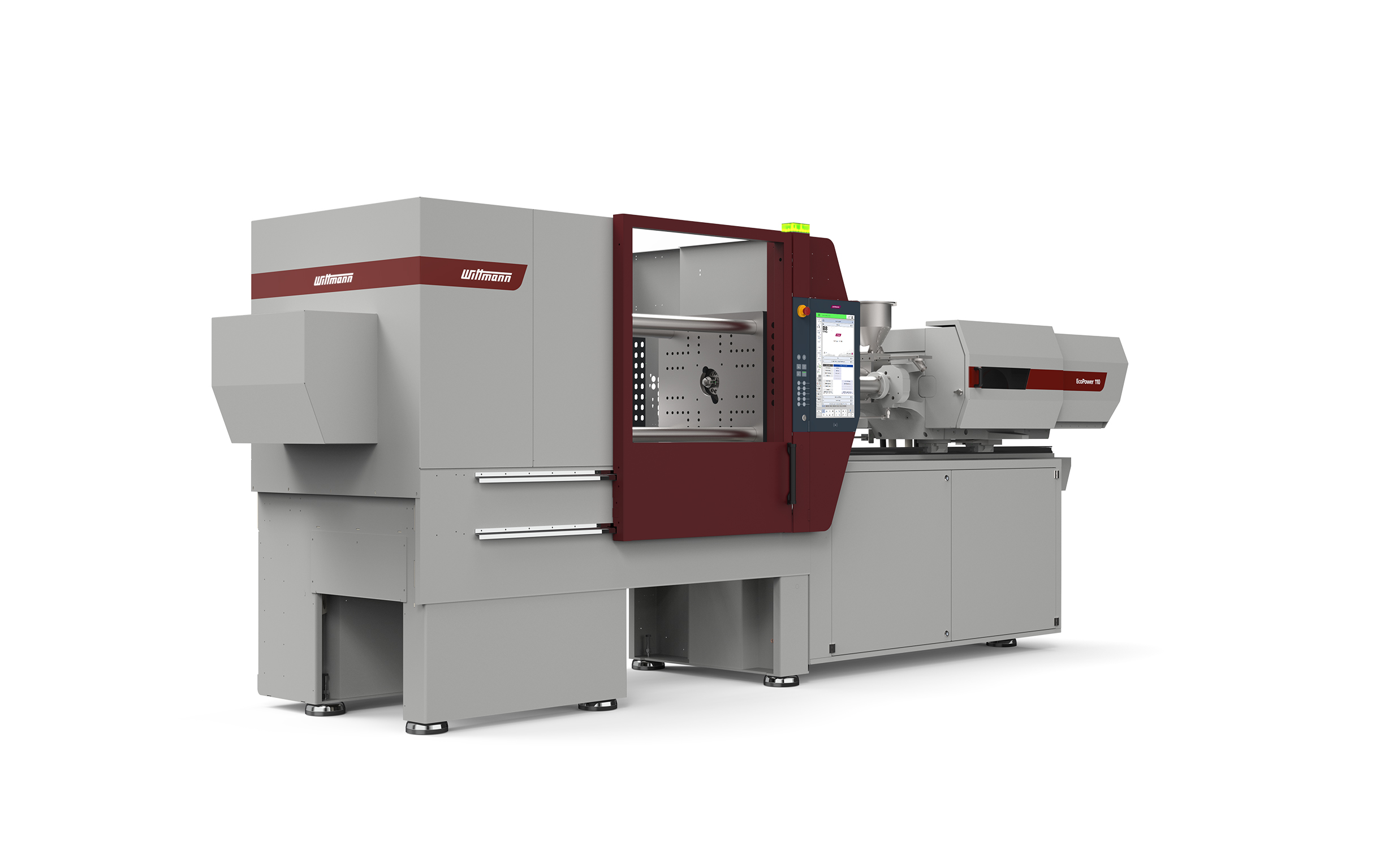
At the K22 trade fair, we presented a prototype fully electric machine powered by direct current. Currently, we can supply the EcoPower series prepared to operate directly with this type of power supply. Key advantages include eliminating energy losses associated with conversion, allowing the direct use of photovoltaic renewable energy. In addition, voltage fluctuations that cause problems during micro-cuts in the power supply are eliminated.
Emission reductions are also achieved through the use of post-consumer and biodegradable materials. In this area, we have developed various EXPERT software packages and specific systems that optimise processes with these materials, ensuring repeatability and the quality of the final product.
Innovations in peripheral equipment have focused on reducing energy consumption, including robots with higher load capacity and temperature controllers with proportional valves that allow continuous flow adjustment.
To reinforce the circular economy, smart recycling is becoming increasingly important. Wittmann develops this concept through solutions ranging from grinders for recovering sprues and defective parts to dehumidifiers, dosing units, and Feedmax Clean feeders, specifically designed to meet this demand and capable of efficiently filtering dust particles, reducing them by up to 80%.
Digitalisation is shaping the future of manufacturing. How do you apply Industry 4.0 principles in your equipment and automation systems?
For years, Wittmann has incorporated 4.0 systems in its equipment, enabling all elements of the process to be connected and controlled, ensuring maximum efficiency at each stage of injection. This connectivity facilitates continuous production optimisation.
Additionally, we offer an energy monitoring system called IMAGO, which allows control of both energy use and the manufacturing process. This is complemented by TEMI+, an MES system that integrates IMAGO data with production control and even allows the calculation of the carbon footprint through an integrated material database.
In the field of artificial intelligence, AIM4 Help AI has been developed, an expert tool based on AI that acts as first-level technical support and facilitates troubleshooting, while providing access to technical knowledge via a web portal.
Digitalisation and sustainability are becoming key factors for the future competitiveness of the industry.
Which sectors are likely to drive the demand for your solutions most strongly in the coming years?
All sectors must incorporate innovation into their processes to remain competitive, so development is not limited to a single industrial field. The automotive sector is highly relevant to our activity, although it is undergoing strategic redefinition amid various uncertainties.
The medical sector has seen notable growth since the pandemic, though it also faces new challenges. Meanwhile, the packaging sector continues to evolve strongly, particularly through solutions incorporating recycled, post-consumer, and biodegradable materials.
Equiplast brings together the main players in the sector. What objectives have you set with your participation in this edition of the fair?
Participation in Equiplast aims to directly demonstrate to clients and visitors value propositions that allow them to develop projects efficiently, sustainably, and viably. Presence at the fair also reinforces Wittmann’s image as a reliable global supplier aligned with real market needs, with a clear commitment to sharing objectives and successes with clients.
Equiplast is also an excellent opportunity to learn firsthand about sector innovations, both technologically and in terms of complementary activities and trends.
What message would you like to convey to professionals visiting Wittmann’s stand during the fair?
The main invitation is to dedicate time to visiting the fair, as it represents a unique national opportunity to maximise the value of available time. The exhibition provides the ideal setting to exchange ideas, raise concerns, and analyse challenges, but also to generate new expectations and shape future projects.